Call for paper : 9th International Congress on Contruction History – Torino June 28 – July 2 2027
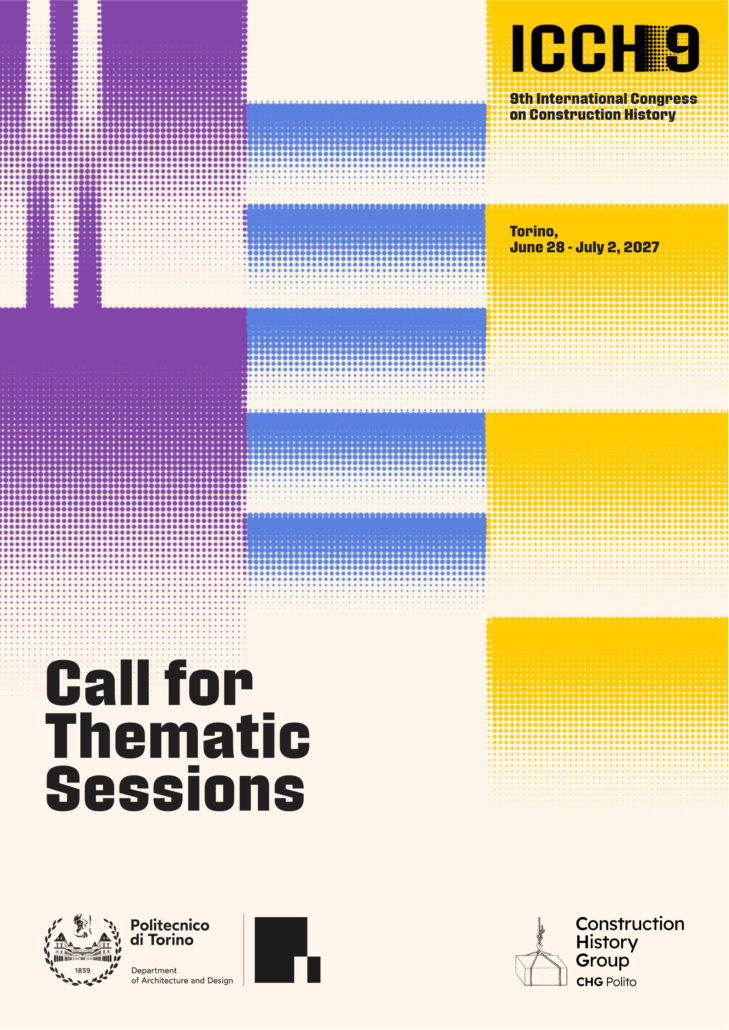
The 9th International Congress on Construction History (ICCH9) will be held June 28 – July 2, 2027, at Politecnico di Torino, Italy.
The ICCH9 will bring together researchers from different disciplines and continents to exchange recent advances, results, and insights in the vast and expanding field of Construction History. Special topics will be discussed in dedicated Thematic Sessions organized and chaired by leading experts, while the scope and diversity of Construction History will be reflected in the Open Sessions.
Researchers from all fields connected to Construction History are invited to submit abstracts of contributions for ICCH9.
Abstracts must be submitted in English and must not exceed 400 words. All abstracts will be reviewed and selected for presentation by at least two members of the ICCH9 Scientific Committee, which includes the world‘s most respected researchers in the field. All papers will be published in an edited open-access proceedings volume and will be available, in digital form, at the
congress.
Abstracts must be submitted exclusively via the website.
https://easychair.org/conferences/?conf=icch9
Abstracts received by other means of communication (e-mail, etc.) cannot be considered. When submitting your abstract, please indicate which of the Thematic Sessions or Open Sessions topics would be the most appropriate for tour paper.
Abstracts have to be submitted by July 04, 2026 (midnight CET). Delayed submissions cannot be considered. The decision of the scientific committee will be announced by August 20, 2026.
Full papers are due by October 30, 2026. Submissions will undergo a further review by members of the scientific committee. Only contributions that fully meet the scientific and language quality criteria will be accepted. Please note that only papers presented in person at the conference will be included in the proceedings.
We look forward to your contributions and to meeting you in Turin in 2027!
Stay informed about ICCH9 by regularly visiting our conference website:
www.constructionhistorygroup.polito.it/icch
Book of Sessions
TS1. Demolition History: Practices of Architectural Dismantling
Armando Antista
Léonore Dubois-Losserand
Gaia Nuccio
The demolition of architectural structures within building sites has been addressed mainly in historical studies addressing the urban scale and the domain of fortifications, often in connection with major operations of urban transformation undertaken in the Nineteenth and Twentieth centuries (e.g., Valérie Nègre, ed., L’Art du chantier. Construire et démolir du XVIe au XXIe siècle, Ghent 2018; Émilie d’Orgeix, De la démolition des villes fortes à l’époque moderne: art, technique et rationalisation, “Revue Historique des Armées”, 298, 2020–2021). More fragmentary, by contrast, is our understanding of the processes through which, in the late Middle Ages and the early modern period, the body of a building was progressively “digested” over the course of its dismantling, within the framework of a circular economy grounded in the recovery and reuse of resources (e.g., Marco Rosario Nobile, Architettura “cannibale”. nuovi progetti e lacerti di distruzioni, “Studi e Ricerche di Storia dell’Architettura”, 6, 2019; Evelyne Bukowiecki, Antonio Pizzo, Rita Volpe, eds., Demolire, riciclare, reinventare. La lunga vita e l’eredità del laterizio romano nella storia dell’architettura, Rome 2021). In this respect, the study of architectural dismantling can contribute to the history of construction from a renewed perspective.
This session seeks contributions on the theme of demolition in architectural construction sites in Europe, within a chronological framework extending from Antiquity to the early modern period, with the aim of reconstructing practices and operational modalities on the basis of well-documented case studies.
Paper proposals may cover the following topics:
· the reuse and recycling of dismantled materials, whether reintegrated into building campaigns involving the transformation or replacement of a structure, or redirected elsewhere. Particular consideration will be given to submissions that illustrate how the introduction of reusable materials into the market relied on established practices and customary procedures, as well as on regulatory mechanisms;
· systems of oversight and legal procedures designed to regulate the demolition of a building within a specific political and administrative context;
· relationships between new and pre-existing structures during the period of their coexistence, i.e., when one building is approaching completion, and the other is bound to disappear, either leaving no trace or leaving discernible marks within the new construction. For a certain interval, pre-existing structures may constitute obstacles while still fulfilling functional roles, and can exert a determining influence on the new architectural design and its material execution.
TS2. Masters,
Craftsmen and Knowledge in Late Gothic Mediterranean Civil Architecture
Emanuela Garofalo
Javier Ibáñez Fernández
Marcello Schirru
Archival sources dating from the 15th to 17th centuries provide a wealth of information on the practices of late Gothic civil architecture in the Mediterranean. Contracting methods, building techniques, materials, construction details, and decorations, either derived from local customs or handed down over centuries within an international cultural environment, developed into a multiplicity of common architectural solutions.
Identifying the Iberian Peninsula, southern Italy, and Sicily as the boundaries of this phenomenon would narrow it to the territories of the former Habsburg Crown. While these territories played a central role, other geographical areas also participated in the late Gothic tradition and should be considered, including Malta, southern France, the Dalmatian coast, Cyprus, and North Africa. Throughout this extended region, the collaboration between professional craftsmen such as stonemasons, carpenters, blacksmiths, glaziers, stonecutters, and earth workers defines a multifaceted operational landscape in which civil construction skills were integrated and perfected over time. These customs have characterized the aesthetics and forms of living at all scales, from stately residences to smaller-scale architecture, outlining an area of research of considerable interest.
The session aims to collect proposals for the analysis and the discussion of late Gothic civil architecture (15th-17th centuries) in the Mediterranean, and is open to the following topics:
· construction techniques for housing: palaces, “minor” buildings, villas, farms;
· materials used in late Gothic civil construction;
· decorations and details of dwellings: windows, portals, staircases, roofs, attics, etc.;
· civil construction vocabulary: materials, construction techniques, professional figures, construction details, cutting and treatment of materials, etc;
· relationships, collaborations, and intersections between workers.
Studies on late Gothic architecture in the Mediterranean region have increased significantly since the turn of the millennium. Earlier research, influenced by localized interpretations and by the conceptual separation between large centers, bearers of high aesthetic values, and smaller centers, considered mere cultural peripheries, has been superseded by a more complex and international vision, supported by increasingly rich archival sources. The knowledge and customs of the craftsmen, as well as the networks of collaboration, techniques, and construction details, are among the topics explored in recent literature and at important conferences. Of particular note is the dissemination activity of the Red Temática de Investigación Cooperativa sobre Tardogótico, which brings together scholars from various Spanish, Portuguese, and Italian universities and is the promoter of this session.
TS3. Black Marbles in Medieval and Early Modern Europe
Caterina Cardamone
Pieter Martens
This session explores the use, circulation, and perception of a specific variety of marble in late medieval and early modern European architecture: black “marbles”, actually jet-black limestones, such as the ones quarried near Dinant in Belgium, or in Derbyshire, England. Since African quarries were no longer accessible to medieval and early modern Europeans, the “nero antico” used throughout Roman antiquity was available only as spolia of relatively small size.
While the use and meaning of black marbles in the architecture of antiquity still requires assessment, throughout the Middle Ages, black and dark stones were associated, because of the absence of divine light, with negative qualities: sin, chaos, mourning, lugubriousness, as in Isidore of Seville’s De Lapidibus et Metallis or in the constructions of La Cité des Dames.
This apparently changed in the fifteenth century, when black marbles became appreciated across Europe for funerary architecture, probably following a fashion initiated at the end of the fourteenth century by the sepulchral monuments of the dukes of Burgundy, made in Belgian black marble. Sepulchers in black marble of unknown provenance appeared in Florence since the 1480s, and black marble slabs from Dinant were used in Westminster for the English royal tombs since the early sixteenth century. It seems that the use of black marble was more widespread in northern Europe than in southern Europe, which also raises the question of whether it was associated with its mainly northern origins or instead referred to Roman antiquity.
We welcome papers that study single monuments or regions where the use of black marbles was particularly significant. They may address the role of patronage in the choice of this material as well as its trade, circulation, and transport. Did transportation routes influence the size of its slabs and blocks? Were large monolithic slabs perceived as more prestigious? Did its transportation also imply a circulation of specialized craftsmen and instruments? Was deep black marble preferred over dark grey varieties? Were uniformly black pieces without veins (“un bel nero uguale, e senza vene”, as one Florentine patron asked in 1604) valued higher or more difficult to obtain than black marbles with white or coloured veins?
Papers may also address issues of perception, terminology, and other specific connotations of black marble. They may be based on material analysis or on written sources, such as building accounts or ‘books of stones’.
This session seeks to overcome a long-standing historiographical limitation that excluded the possibility of significant north-to south Renaissance influences in European architecture. Situated at the boundary of construction history, it seeks to engage both material and cultural dimensions, also raising technical questions concerning quarrying, supply routes, and the circulation of workers. By bringing together analyses of monuments, trade networks, patronage, and textual sources, the session encourages dialogue among archeologists, historians of construction, architectural historians, material culture scholars, and those working on the history of ideas.
TS4. The Early Modern Machine Model Book in Its Entirety
Elizabeth M. Merrill
The study of early modern machine model books (c. 1300-1700) spans fields of contemporary academic specialization. As highly visual, graphic compendia of machine design, the books would seem to belong to the ambit of the art historian. But in terms of their subject matter — namely, applied mechanics — the books fall under the purview of architectural historian, or better, the historian of construction and technology. As bound compendia — volumes that were deliberately assembled and often conserved for posterity in important library collections — the model books merit codicology study. Finally, an understanding of textual component of the books, which take the form of recipes, postils or marginal annotations, often recorded by multiple hands over an extended period, benefits from the insights of someone with expertise in paleography.
The proposed session invites contributions that confront early modern machine model books as complete objects. Participants are invited to present on objects composed in the period between 1300 and 1700, from any geographic or cultural context. The overriding principle is methodological: the machine book is considered in its entirety, bringing to bear the totality of its material, visual, and textual evidence. Although academic training and expertise present legitimate limitations — the background and interests of the architectural historian are fundamentally different from those of a codicologist, for example — the session challenges participants to acknowledge the multiple dimensions of bound compilations of machine drawings. Put differently,
the contributors are asked to consider the extended life of the machine model book, and how each of its components contributes important information about its origins, its makers, and its function as a transmitter of human experience and knowledge.
In the last thirty years, the history of early modern machine drawing has received critical contributions by historians of science and technology. Paolo Galluzzi’s Prima di Leonardo (1991) remains a canonical source for scholars interested in the Italian machine drawing prior to the sixteenth century, with pointed (albeit brief) summaries on numerous manuscripts and single sheet drawings. The studies of Marcus Popplow and Wolfgang Lefèvre (2003, 2006) offer a greater contextual framework for understanding the development of machine drawing in a broader European context, with a specific focus on the epistemic function of graphic models. While these publications, and others, have been instrumental for advancing our understanding of early modern machine drawings, the graphic conventions they employed, and their ubiquity in diverse contexts, they frequently isolate the drawings from the material supports that allowed for their circulation. The way model books were produced and by whom remains little studied. Similarly, there are substantial lacunae in our knowledge of who owned and collected the drawings, and the functions they filled for different audiences. A driving assumption has been that the majority of model books produced prior to the sixteenth century were presentational manuscripts, directed to patrons and held in elite libraries. But the materiality and visual use of the many early manuscripts suggests otherwise. What does this tell us about the education and background of the building designer in this period?
TS5. History of Construction and Common Walls
Michela Barbot
Robert Carvais
The concept of shared ownership is common to many civilisations from ancient times to the present day, as it stems from the fact that individuals rarely build their homes in isolation. The process is usually carried out collectively and involves dividing up plots of land either with boundary walls or, in densely built-up areas, with party walls. The buildings occupying the foundations of all plots are then attached to one another, giving rise to various problems. The concept of joint ownership essentially reflects a legal institution dating back to Roman law, a ‘joint ownership of the neighbourhood’. Nevertheless, it is at the heart of material construction issues and leads to financial problems. It has also given rise to a wealth of literature, both among experts in the field and among lawyers.
Although it is primarily a legal issue, the procedure for establishing joint ownership is addressed and discussed in practice by lawyers, contractors, engineers and architects alike. The approach varies depending on the case and the country, but one common feature in all theoretical and practical situations is the use of graphic representation (to position the wall on the plots and recognise joint ownership). Case studies are increasingly common in textbooks. A multitude of cross-sectional representations, models (Cnam) and educational sketches are necessary to accurately record joint ownership. Experts systematically draw up a dimensioned plan of the walls, while law professors use cross-sections (Carbonnier). These representations are justified because joint ownership is proven by visual signs.
As for the practical aspects of shared walls, these revolve around practical questions concerning authorised construction methods. While wood is generally not recommended, all approved materials are selected based on specific criteria of strength. Shared walls often serve as load-bearing structures for adjacent elements that are attached to them (see the question on counter walls). Since the 19th century, in the absence of load-bearing walls, buildings have been constructed with concrete and steel frames filled with bricks that are often translucent and unable to withstand lateral forces or allow the intended use of party walls. Finally, several strategic elements may be considered dangerous due to their risk of fire transmission, such as ovens, forges and chimneys.
Building, renovating, repairing, heightening or demolishing and rebuilding a party wall raises financial questions, especially since the operation involves two neighbouring owners who, in principle, share the costs equally. If such work is ordered by one of the neighbours, it is inevitable that the other neighbour will refuse to pay their share of the costs, considering themselves to be unfairly constrained. He may be released from this obligation if he relinquishes ownership of the strip of land on which his share of the party wall stands. This situation is the source of many neighbourhood disputes. The resolution of such disputes argues for the usefulness of shared walls, or ‘joint ownership of the line’, according to 19th century economists. But is joint ownership a source of savings?
TS6. Words of the Building Site: Towards a Glossary of Early Modern Construction
Valentina Burgassi
Construction sites in Early Modern Europe were multilingual, highly specialised environments in which skilled craftsmen, architects, engineers, and labourers negotiated their tasks through a shared yet stratified technical language. These vocabularies circulated across the European courts, major building sites, and transnational networks of artisans. Despite their historical significance, the terminology employed in seventeenth- and eighteenth-century construction practice remains dispersed across archives, inconsistently recorded, and rarely examined as a comparative European phenomenon.
This session is anchored in the international European project COST ACTION CA24102 – EUROGLOSS, launched in 2025 with the aim of producing a multilingual digital glossary of construction techniques derived from archival reports, drawings, and specifications from Early Modern European courts. It presents the initial outcomes of this collaborative endeavour, which brings together construction historians, architects, linguists, archaeologists, and digital specialists to reconstruct the language, practices, and material culture of historical building sites.
By 2027, EUROGLOSS will have completed several key milestones, including the development of an initial corpus of terms and construction techniques that shed new light on the linguistic, material, and procedural dimensions of Early Modern construction. This corpus forms the foundation for a comprehensive glossary and offers fresh perspectives on the organisation of building sites, the transmission of knowledge, the geographies, and the expert language of early construction practice.
The session welcomes papers based on original research, particularly those addressing:
· the coexistence of learned terminology within the technical language of craftsmen;
· the cross-regional circulation of construction terms through craftsmen, architects and artisans mobility;
· terminology emerging from site reports, drawings, estimates, contracts, and other technical documents;
· regional and linguistic specificities within European court contexts;
Contributions that highlight lesser-known actors, underexplored archives, or comparative perspectives across different European regions are especially encouraged.
The study of construction technical terms is essential to understanding historical building practices. Technical terminology reflects materials, techniques, tools, craft hierarchies, geographies, and the transfer of knowledge across Europe. This session responds directly to ICCH9’s call to foreground innovative methodologies, comparative analyses, and interdisciplinary approaches in construction history, introducing new methodologies, datasets, and digital tools, including AI-assisted reading of archival material and collaborative, multilingual terminology work.
EUROGLOSS COST ACTION (Horizon Europe) supports the session by offering co-funding and/or conference grants for young researchers and participants, enabling participation and ensuring inclusiveness across broader regions. This will help create a forum for discussing terminology, techniques, and knowle0dge exchange in Early Modern construction history.
TS7. Building Together: Collective Works and Collaborations in the “Worlds” of Construction, Eighteenth – Twentieth Century
Veronique Boone
Guy Lambert
Building is undeniably a collective activity, although the increasing division of labour from the 18th century onward contributed to greater specialization in the professions of architect, engineer, and contractor. The relationships between them fluctuate between rivalry and collaboration, which can be seen as much in the way projects are conducted and carried out as in interprofessional relations in general or in the image that these professions have of themselves. In construction history, the study of projects and achievements often highlights the role of these protagonists, but the study of their work, even when it considers the collaborations with the other actors, tends to examine them through a monographic approach that nevertheless assumes the autonomy of the “heroes”. At the interprofessional level, collaborations between architects and engineers are the most widely studied.
By focusing on collaboration, this panel aims to consider it as an interface between distinct professional skills and responsibilities, and as the pooling of multiple knowledge and expertise. It is not a question of seeing how the construction process brings together architects, engineers, and contractors in succession, but rather of focusing on forms of collective work in the “worlds” of architecture (to use Howard Becker’s term). For several years now — perhaps echoing today’s practices of “collectives” or, more recently, the development of collaborative work tools — these topics have made historians more attentive to processes that had recently interested sociologists as Richard Sennett.
This session aims to examine the practical conditions for such collaboration, through the actors involved, the tools required, and the need to build a shared culture. Opportunities to build together are numerous, driven by circumstances, opportunities, constraints, a shared desire, or external demand. Depending on the era, this may involve designing buildings for world fairs or the Olympic Games, complex structures, industrialized processes (which require different ways of controlling the construction process over time), and so on.
Abstracts may cover the following topics:
· individuals who are conducive to collaboration, such as auxiliary staff like consulting engineers, who, through their business travel, act as vectors or intermediaries between different firms or different geographical areas;
· the way in which these collaborations are organized, including timing of exchanges, means of communication, and agreement;
· what collaboration changes, for each of the partners involved, in their ways of working within the thinking–creating–making triangle, extending beyond oneoff opportunities.
TS8. The Role of Professional Associations of Engineers, Architects, and Industrialists in Promoting Construction Knowledge, Eighteenth – Twentieth Century
Antonio D’Andrea
Davide Luraschi
Carlo Rottenbacher
Mauro Volpiano
This session examines the pivotal role played by professional associations of engineers, architects, and industrialists in shaping, disseminating, and internationalizing construction knowledge from the eighteenth to the twentieth century. Emerging in the Enlightenment era, these associations expanded significantly throughout the nineteenth century and into the early twentieth century, becoming essential arenas for the negotiation of technical expertise, professional roles, and interdisciplinary exchange.
Far from being limited to engineers and architects alone, these organizations brought together builders, industrialists, scientists, physicists, and other actors engaged in the transformation of the built environment. Thus, technical societies became spaces where heterogeneous professional backgrounds converged, fostering dialogue and debate that contributed to the formation of modern professional identities.
Their activities — ranging from participation in architectural competition juries, exhibitions, and congresses to the publication of journals — positioned them as key mediators in the circulation of constructionrelated knowledge across national borders. Through these channels, they contributed to the emergence of shared standards, the comparison of technical solutions, and the diffusion of experimental practices at a moment when industrialization and urban growth were reshaping both the scale and the complexity of building processes.
Despite their importance, the history of these associations remains relatively underexplored: printed sources and archives are often still insufficiently studied, leaving significant gaps in our understanding of how technical knowledge was produced, debated, and institutionalized.
TS9. Craft, Capital, and Change: Stonemasons in the Nineteenth Century
Jennifer Alexander
Alexandrina Buchanan
Nina Baker
The nineteenth century was a period of profound transformation for stonemasons internationally, as traditional modes of craft production were reshaped by industrial, architectural, and technical change. This session will examine the shifting world of the stonemason within a century that saw the rise of general contracting, the spread of mechanised stone-cutting technologies, and the flourishing of revivalist architectural styles. Whilst previous scholarship has explored how these developments affected the organisation of labour and the status of craft, there has been little exploration of their impact on the lives and identities of those who worked in stone.
The emergence of general contractors increasingly displaced the older, direct relationships between masons and architects or clients, creating new hierarchies of control and profit that challenged the autonomy of skilled artisans. Mechanisation, through steam-powered saws, planers, and cranes, redefined both productivity and skill, provoking debates about craftsmanship, deskilling, and the value of handwork. To what extent were stonemasons directly involved in these discussions? Simultaneously, the Gothic and other stylistic revivals created a complex demand for ornamented stonework that both sustained and reconfigured the mason’s role as an artist-artisan within large building projects.
This session will also consider the mobility and organisation of the stonemason’s workforce. Many masons travelled between regions and even countriesin search of work, creating networks of expertise that linked urban centres, quarries, and monumental sites. Training practices evolved from traditional apprenticeship models to more formalised systems of technical education, reflecting both the persistence and adaptation of craft traditions. Finally, industrial relations within the building trades, exemplified by the many documented stonemasons’ strikes, highlight the growing collective consciousness and political activism of skilled artisans confronting industrial capitalism.
TS10. Construction as Flow: Materials, Energy, Labour, and Capital in the Making of the Built Environment in the Nineteenth and Twentieth Centuries
Stephanie Van de Voorde
Adam Przywara
Lara Reyniers
Ine Wouters
Construction has long been one of the most resource-intensive activities in society. Across time, vast quantities of materials, energy, labour, and capital have been mobilised, organised, and channelled into the production of buildings and infrastructure. During the nineteenth and twentieth centuries, the pace and scale of these processes intensified dramatically through industrialisation, expanding markets, and increasingly complex regulatory, technical, and financial frameworks. Yet despite this fundamentally dynamic character, construction history has often remained centred on the completed building as a relatively static object.
This session proposes flow as a central analytical category for the study of construction history. Rather than approaching materials, energy, labour, and capital as separate domains, it asks how they were coordinated, negotiated, and assembled in the making of the built environment. Its aim is to examine buildings and infrastructures as provisional condensations of wider circulations: of raw materials and manufactured products, of embodied and mechanical energy, of labour and expertise, and of investment, credit, and value. In this way, construction emerges not as the end point of those processes, but as a site where multiple flows converged, were stabilised temporarily, and generated effects that extended far beyond the building site. The session asks how these flows came together in construction processes and how, in doing so, they both responded to and helped shape broader political economies, social relations, and environmental transformations over time.
We invite papers that explore one or more of these flows while situating their analysis within a broader field of interrelations. Contributions may examine how materials moved from extraction and production to use, reuse, and disposal, passing through complex supply chains and multiple hands; how energy regimes reconfigured construction practices and building cultures, through shifting relations between labour and mechanical power and between artisanal and industrial modes of production; and how financial flows, visible in credit systems, cost calculations, investment structures, and regimes of valuation enabled, structured, or constrained particular configurations of materials, labour, and energy. The session is especially interested in analyses that show how changes in one domain reshaped possibilities in another: how capital reorganised labour, how energy regimes altered material economies, or how new material circuits transformed practices of maintenance, reuse, and waste.
Particular attention will be given to contributions that connect micro and macro dynamics. At the microscale, contributions may focus on the situated practices through which materials, labour, energy, and capital were assembled on the construction site, including the roles of skill, mediation, negotiation, improvisation, and decision-making. At the macroscale, they may examine the wider industrial geographies, political economies, technological and energy regimes, labour systems, regulatory frameworks, and shifting regimes of valuation that shaped the production of the built environment. We particularly encourage papers that analyse construction flows in terms of their conditions, mechanisms, and effects.
This session builds on an emerging field of inquiry that shifts attention from buildings as static objects to the flows that underpin them, by bringing a specifically construction-historical perspective to the study of flows. In doing so, it highlights that materials, energy, labour, and capital were not only circulated, but also coordinated, negotiated, and assembled in construction processes, and how buildings can be understood as provisional condensations of these wider dynamics. By foregrounding the conditions, mechanisms, and effects of construction flows, this session aims to expand the methodological toolkit and thematic range of construction history, while fostering cross-disciplinary dialogue with adjacent fields such as environmental, labour, and architectural history.
TS11. Material Movements
Martina Motta
Martino Lorenzo Fagnani
The objective of the Material Movements panel is to challenge the conventional understanding of building materials as “inert.” Within the historiography of architecture and construction, materials have zredominantly been examined from a technical and structural perspective, with emphasis on their application in design and their contribution to architectural style.
The session calls for an examination of building materials at a broader scale. Conceived as a part of a wider network of architectural production, materials are anything but inert. Investigating materials as agents — and thus as catalysts for a multiplicity of actors, bodies of knowledge, practices, and places — enables the articulation of a more complex and polyvocal history of architecture. Such a history originates in the territories of extraction, unfolds through the infrastructures and labor practices that enable the material’s circulation and transformation, and ultimately culminates in the architectural artefact in which the material is embedded.
By foregrounding the relationship between building materials and their territories of origin, the panel also highlights the environmental impact of architecture. From this perspective, contributions that bring to light the social, political, and ecological implications associated with material practices are particularly encouraged. The circulation of materials thus becomes an interpretive framework for unpacking the often unequal relationships activated by construction processes within specific territories. The panel aims to gather accounts of materials’ trajectories from multiple vantage points: the actors involved in extraction processes, procurement and contracting practices with builders and merchants, modes of transportation and the figures implicated therein, as well as episodes of conflict involving the ownership and control of raw materials. No fixed chronological framework is proposed. Rather, the panel welcomes contributions that help delineate a longue durée perspective on how issues related to building materials have evolved over time, and how these transformations have shaped architectural history.
TS12. Approaches to Film in Construction History: Methodologies and Critical Perspectives
João Mascarenhas-Mateus
Maria Grazia d’Amelio
Francisco Domouso d’Alba
This thematic session proposes to explore moving images as a significant and underutilised source for the study of construction history. It seeks to consolidate and extend emerging research on film as historical evidence, building upon recent initiatives, including the International Symposium on Construction History & Film held in Lisbon from 19 to 20 February 2026. By bringing together construction historians from different disciplinary backgrounds, the session aims to stimulate critical discussion, share recent findings, and develop innovative perspectives within this growing field of inquiry.
Since the late nineteenth century, film has recorded multiple dimensions of social and material life, including the processes and cultures of building. Like earlier visual and artistic media, moving images have documented construction activities in urban, rural, and natural settings, as well as the conservation and transformation of existing structures. Newsreels, industrial films, documentaries, and educational productions constitute key historical sources that reveal the extraction, transport, and use of materials; the deployment of machinery and building techniques; and the organisation of labour on construction sites. They also capture the professional practices of architects, engineers, and master builders, as well as the everyday experiences and leisure activities of workers.
Moreover, film sources document the symbolic and social dimensions of construction, including foundation ceremonies, inaugurations, political demonstrations, and public celebrations. In the twentieth century, these communicative practices were increasingly mediated through television and, more recently, digital platforms. Contemporary documentary and educational productions continue to disseminate knowledge about historical building practices, contributing to public awareness and engagement.
The session welcomes contributions that examine historical building cultures through film-based sources, particularly those that employ innovative methodologies or present new empirical insights. Proposed subthemes include: · archives, research questions, and methodological approaches to film in construction history; · representations of new construction since the late nineteenth century; · restoration, maintenance, and renewal in moving images; the dissemination of construction history through film and audiovisual media.
This thematic session addresses a growing need within construction history to expand and diversify its source base and methodological approaches. While written and material sources remain fundamental, moving images provide unique insights into building processes, labour relations, technological change, and professional practices that are often absent from traditional archival documentation. Film captures dynamic interactions, spatial conditions, and temporal sequences that are essential for understanding construction as a technical, social, economic and cultural activity.
By foregrounding audiovisual materials, the session contributes to broader debates between construction history and visual culture, media history, and heritage studies. It also encourages interdisciplinary dialogue between historians, architects, archivists, and media scholars. In doing so, it strengthens the analytical tools available to construction historians and enhances the visibility of the field within both academic and public contexts. The session therefore aligns closely with the Congress’s aims to promote innovative research and international collaboration.
TS13. The Interchange Between Engineers, Construction Companies, Scientists, and Academic Institutions in the Development of Large-Scale Structures at the End of the Nineteenth Century
Rolf Hoehmann
The research on the development of large bow arch bridges in continental Europe in the last quarter of the 19th century has clearly shown that there were close connections and information channels between engineers, scientists and construction companies all over Europe, notwithstanding the nationalist and even hostile movements in neighbouring countries. New developments were constantly observed and analysed, and publications exchanged. In particular, the research and theories of Prof. Culmann were widely and nearly instantly adopted, with some of the engaged engineers being pupils of his institute at the Swiss Technical High School in Zürich. Other engineers moved from their home countries to other states, and international competitions (as for the Cernavoda Bridge in Romania) influenced the exchange of men, materials, construction methods and companies. One example is the Swiss engineer Jules Roethlisberger, who became technical director of the SNOS in Savigliano in Italy. The exchange with the Anglo-American engineering scene is not yet sufficiently researched, although many engineers emigrated to North America from Europe.
Large span bridges are among the most important construction types in the history of engineering. Since the introduction of iron and steel at the beginning of industrialisation, bridge construction was pushed to new limits — a development which is still ongoing. The importance of bridges is well known in the engineering circles, but not sufficiently reflected in international programs like the World Heritage List of the UNESCO. While ancient and medieval stone bridges from many countries are part of the list, only the Forth Railway Bridge represents the Industrial Age – totally justified in its uniqueness. The tentative list nomination for the Brooklyn Bridge in New York suffers from the withdrawal of UNESCO membership by the US Government. Since a decade, a German initiative to pursue a combined serial nomination for large bow arch bridges including examples in Portugal, France, Italy and Germany revealed the close connections between engineers in these countries, which should be researched further.
TS14. Vertical Urbanism: A Pre-History
Marci Uihlein
Thomas Leslie
In October, 2025, the Council on Tall Buildings and Urban Habitats (CTBUH) announced a rebranding; it will henceforth be known as the Council on Vertical Urbanism. The new name suggests a shifting in emphasis from pure height to a more nuanced advocacy for the role of the third dimension in city life. But it also reflects the rich evolution of skyscraper design from late 19th- and 20th-century paradigms that saw the type as predominantly structural to one that orchestrates a far richer, more complex set of values and expertise, ranging from climate control to user experience. While these “other” skyscraper histories have always been present, they have been understudied and underrepresented in the literature; more recent scholarship has begun to address these aspects of high-rise design, construction, and occupation. This session seeks papers that reveal the richer and more tangled story of high-rise construction, function, and occupation. In particular, we are interested in histories that could include environmental design, labor, finance, user experience, demolition, or historic cases of adaptive reuse. Papers that focus on structural or material aspects are also welcome, particularly if they reveal previously hidden aspects of these structures. We take a very open definition of “skyscraper”: ancient, medieval, or industrial era “tall” buildings are welcome as subjects, as are building types that do not meet traditional definitions of “skyscraper” but have purposes, methods, and/or lived experiences that are
essentially “tall”.
The CTBUH rebranding is symptomatic of an industry-wide shift in why skyscrapers are built and how they are perceived. Post-pandemic working standards have changed radically, with work-from-home sapping commercial demand, while affordability crises in many countries have pushed cities and developers toward denser solutions. Such paradigm shifts in tall building are not new; the skyscraper as a type has constantly evolved, often because of economic, social, cultural, or environmental forces that are not always apparent on the surface. By showing how skyscraper history is rich with sudden, often drastic shifts, the session hopes to put contemporary debates in context.
TS15. Construction Histories of Global Oil Infrastructures
Maryia Rusak
Giulia Scotto
Oil has profoundly transformed not only our daily lives, but also the environments we live in. The commercial discovery of oil fuelled the construction of an entirely new global infrastructure: onshore and offshore drilling platforms, refineries, storage depots, service and distribution stations, all connected via an elaborate network of pipes, ducts, terminals and shipping links. From the deserts of the Middle East to the coastlines of West Africa, from North American hinterlands to European urban centres, the unprecedented scale of this infrastructure not only enabled the global circulation of petroleum but also impacted methods, standards, and technologies of modern construction. For example, new oil structures relied on high-performance materials
and improved load-bearing systems capable of withstanding extreme environmental conditions. Rapid global expansion of oil infrastructure prompted the adoption of modular construction systems, industrially prefabricated components and new project management techniques. International pipeline networks demanded a radical rethinking of logistics, expanded maintenance regimes, and negotiation of cross-border construction practices. At all scales, oil infrastructures served as a laboratory for advancements in structural engineering, materials science, durability strategies, and project management. In this process, oil companies — supported by their own in-house engineering departments and by external architects, contractors, and consultants — became powerful actors in shaping the built environment. Their technical networks and managerial cultures also impacted the construction industry, promoting standardisation, new forms of technical expertise and globalisation of building practices.
This thematic session proposes to investigate the construction histories of oil infrastructures, zooming in on the specific points of connection where the demands and developments of the oil industry have shaped the contemporary building culture. The session is interested in both the micro-histories of specific additives, new materials and building methods, as well as broader inquiries into selected oil structures, the role of oil companies, and new networks of expertise. Rather than charting positivistic histories of “oil innovation”, the panel aims to investigate the inevitable implication of the building industry in practices of resource extraction. We aim to highlight the physicality of artefacts within oil extraction infrastructures and map the far-reaching impact of oil on different domains of everyday life. We are interested in case studies of oil infrastructure across the globe, from the 19th century to the present, connecting local construction histories and site-specific details with broader geopolitical dynamics, including colonial and postcolonial encounters, Cold War alliances, and the contemporary debates on energy and resource sustainability.
The session proposes a novel approach for construction history, re-reading it through the lens of a single immaterial material — oil. Rather than adopting the recent approaches of environmental historians and geographers that examine the ecologies of oil circulation, the panel builds on the disciplinary perspective of construction history to specifically highlight the interdependent relationship between oil and the construction industry. It foregrounds new actors — oil infrastructure and oil companies — as central drivers of innovation in the building industry. By bringing together research on a range of physical objects — pipelines, refineries, platforms, and service stations — as well as less-material innovations in engineering, logistics, and project management, the panel aims to reveal the profound, and often overlooked, impact of oil on the building industry. By doing so, we aim to foster an interdisciplinary dialogue between architectural, infrastructural, and environmental histories to expand the field of construction history beyond conventional single-object case studies. Bridging micro-histories of specific materials and building sites with macro-histories of the global politics of resource extraction, the panel will yield a balanced, materially grounded investigation of the construction histories of global oil infrastructures.
TS16. The Other of Concrete: Earth, Brick, Stone and Local Building Crafts in the Arab Region, 1900 – Present
Faiq Mari
Nadi Abusaada
Abdulrahman El-Taliawi
With the introduction of Portland cement into the Arab region in the 20th century, concrete upended local building techniques and crafts, challenging not only formal aesthetics but also relations of production. Concrete’s “others” were sometimes defeated crafts or craftsmen, relegated to museums or anthropology books; other times they were materials appropriated as veneers to cover concrete’s cold structures, and yet other times they were resurgent techniques and builders attempting to challenge and dethrone concrete as vernacular practice. These others constituted and continue to constitute an important aspect of concrete’s history, even if seldom told as such. Their history is often told separately, even though they are united in their relation to concrete as a material representation of capitalist and colonial forces that continue to shape life in the region.
This thematic session reads through the material and technical interaction between concrete and its others as fragments of socioeconomic and geopolitical histories of the region. It proposes to invite emerging scholars from the Arab region who have been engaging the fields of Architectural and Environmental History through local building materials and vernacular construction practices that came to be undermined by the advent of Concrete as the material of Modernity. In the Arab region, Modernity
coincides with Colonialism.
n line with the shift introduced by the proceedings of ICCH8 (2024) to include more recent histories in the front and center, the temporal scope will focus on the building landscape of the Modern Middle East. It invites scholarship engaging with shifts and transitions in Earth, Brick and Stone building materials and practices as ‘others of concrete’ during the 20th century and the ways in which they persist in our contemporary realities.
The research of the thematic session’s conveners tie a thread between the reinvention of building with earth as vernacular architecture in the moment of its decline by British officials in Egypt at the turn of the 20th century, through the interruption and appropriation of stone building crafts in British Mandate Palestine, to a contemporary search for alternatives to concrete in the Jordan Valley of Palestine pursued through earthen architecture — on the one hand harkening back to a historical craft and building technology, and on the other attempting to treat contemporary issues that proponents of adobe saw concrete to underperform on. Combined, they relate building materials and construction traditions to wider climatic, ecological, and political concerns, in which building materials double as modes of resistance and practices of local agency. Contributions by invited scholars are expected to trace transitions through the lens of Concrete’s hegemony as a reflection of wider historical and political conditions that framed its introduction and continue to be formative to the present day.
A review of the proceedings of the past Construction History editions clearly shows that the nascent field has to-date been dominated by European perspectives. While Global South and Asian voices have featured in previous conferences, rarely has there been case studies from the Arab region. The current proposal for a thematic session presents an opportunity to widen the field to this previously underrepresented part of the world. It aims to platform the work of emerging Arab scholars who have been engaging the discipline from a variety of standpoints, the span of which bridges modern history to contemporary popular struggles. In particular, the panel attempts to shed light on histories of building material and construction practices that intersect with wider problematics concerning the built environment in the advent of Modernity and Colonialism. It will invite contributions that navigate the historical role of construction and materiality in the climate crisis, as well as the place of building crafts and built environments in questions of social equality, local agency and struggles of liberation rooted in the formation of the modern Middle East.
TS17. How Construction Shaped Globalisation: Current “Asia as Method” Approaches
Shu Chang-Xue
What roles did Asian construction activities play in the rise of the modern building industries in Europe, North America, and Australasia during the 19th and 20th centuries? This session invites contributions that examine anew the roles of Asian knowledge, materials, and techniques in shaping globalisation.
It is well-established that construction in Asia has been intertwined with overseas trade (by land or water), intensive agriculture, mining, shipbuilding, railway development, migration, missionary work, weaponry, and Western science and technology. However, traditional narratives in World History tend to portray construction as a secondary process that follows political, economic, and institutional powers within the conceptualised framework of globalisation. Moreover, prior studies by historians of construction and engineering often depict Asian construction activities dominantly as the result of a one-way traffic, where modern technology diffused from the West to other parts of the world.
This session seeks to reconceptualise Asian knowledge, materials, and agents as active elements in the globalised processes of construction. Drawing on the “Asia as method” ― a perspective developed in Science and Technology Studies (STS) and informed by postcolonial and decolonial critiques — the session challenges the idea of unidirectional diffusion. It emphasizes the active, reciprocal, and interconnected roles that Asian construction has played in global history. Like STS, here the term “Asia” or “Asian” primarily refers to people and historical geographies and should be understood in a relational, contextual, and historical manner.
Authors are encouraged to view Asia-related construction practices as laboratories of knowledge production and materialisation through the approaches below. Construction can be historicised as capable of producing social, material, and technological impacts, but also in homogeneous processes across cultural and technical lives. Papers that explore less-obvious pathways, mechanisms, and sources are especially welcome as well as those addressing the following topics:
· the roles of Asian materials, techniques, and skilled labour in the circulation of construction knowledge;
· construction as a laboratory of experiment and innovation, stimulating exchanges of material and intellectual sources from Asia and beyond;
· construction as a catalyst in reconstituting social- material systems and generating (sometimes unexpected) consequences;
· localised understandings of the globalized concepts such as “modern”, “science”, “technology”, and “Asia”;
· specific challenges faced by Western building industries caused by Asian conditions;
· methodological reflections including the use of Asian source materials, developing new theoretical frameworks, and critical engagement with existing literature.
Although Construction History has approached the globalised building industry in a way distinct from previous architectural historians, building activities in/related to Asia have been discussed and historicised largely through a diffusionist lens, viewing technical circulation as from the West to other parts of the world and from central, core areas to peripheral regions. Often, Asian construction activities have been apportioned into enclaves that serve to inform and reinforce the established key themes, frameworks, and epistemic approaches of CH built mostly upon Western experiences.
This session intends to challenge such traditional viewpoints by focusing explicitly on the roles of Asia-related construction activities in the rise of modern Western building industries. Building on the success of the thematic session “how construction shaped globalization” at 8ICCH (Shu 2024), this new call for 9ICCH seeks to revisit and deepen that inquiry of how to historicise building activities in and around the geography of Asia. It will introduce the “Asia as Method” approach from STS and the history of science and technology as a framework for analysing construction matters anew.
TS18. Rebuilding Methods and Construction Issues During and After the Second World War, 1937-1949
Zhenyu Zhu
Haiqing Li
Thomas Coomans
As the third decade of the 21st century unfolds, humanity has not experienced the global peace and stability it had sought; war remains an unavoidable reality for the international community. The built environment often suffers severe damage during conflicts, and destruction persists in many places around the world. Partial rebuilding during wartime and complete rebuilding after wars inevitably raise a crucial question: what construction methods can be adopted to improve efficiency? This question involves more complex issues underlying these con struction methods, including technical capabilities, work organization, policy orientation, resource allocation, and even societal visions of rebuilding objectives. All these issues involve and express the resilience of populations during and immediately after wartime. In this regard, the experience and un precedented scale of WWII still offer valuable insights for today’s world.
The field of construction history has accumulated significant research on the relationship between war and construction methods. Journals and conferen ces, notably sponsored by the Construction History Society, have published a number of papers examining the adaptation and adjustment of construction methods during and after WWII. Studies on the con struction of military barracks (Draper, 2015a), hydraulic engineering in wartime (Zhu & Li, 2024), temporary structures (Draper, 2015b), and the development of reinforced concrete technology (Trout, 2014), among other topics, show how WWII led to adaptive changes in construction technologies, materials and organisational modes, revealing the resilience of construction methods in extreme conditions. However, existing academic work focuses primarily on the ‘construction history’ directly related to WWII, often overlooking general and normal construction activities prompted by WWII, among which one of the most significant is the ‘history of rebuilding’, which directly benefits civilians. In this context, this the matic session focuses on ‘rebuilding’, exploring how specific construction methods were implemented during and immediately after WWII, and what their characteristics are. Relevant topics include, but are not limited to:
·key building materials, techniques, and labour in wartime and post-war rebuilding;
· international transfer of construction technologies for post-war rebuilding;
· comparative studies of rebuilding during war with rebuilding after the war;
· building strategies for sustainable post-war rebuilding;
· interactions between technology, society, and culture as reflected in resilient rebuilding practices.
This session’s temporal scope encompasses the period from 1937–1938, when Japan launched its full-scale invasion of China and Germany annexed Austria, to 1949, when NATO and the PRC were established—two events that consolidated the bipolar structure of the Cold War. Geographically, it covers Europe, the Soviet Union, China, East Asia, South-East Asia, the Pacific region, and North Africa. Of particular note, military architecture such as for tifications and defensive lines falls outside the scope of this thematic session.
This theme aligns with the fundamental concerns of the international construction history, which has long focused on ‘key materials, techniques, and various actors’, while incorporating perspectives from the history of technology and cultural-historical
considerations. The study of construction in the context of war highlights the interactions between technology and culture in extreme conditions, thus emphasising the contemporary relevance and critical potential of construction history research.
TS19. Beyond the Limits: Lightweight Large-Span Metal Roofs for the Postwar Industrial Development
Renato Morganti
Edoardo Currà
Matteo Abita
The postwar period was marked by profound economic and social transformation, not only in Europe: the reconstruction and the subsequent economic boom of the 1950s and 1960s led to an unprece dented surge in industrial development. Against this backdrop, the construction sector was tasked with meeting the growing demand for functional, flexible spaces for new manufacturing, logistics and commercial infrastructure.
One of the most significant building challenges of that period was the need for large-span roofs without intermediate vertical supports, which presented technical challenges, prompting an intense period of research and experimentation. Metal construction emerged as the preferred solution, owing to the superior structural efficiency of iron and steel. The paradigm of lightness became a guiding design principle, with research efforts focused on optimising material use and maximising mechanical performance while minimising weight, an approach that represented one of the fundamental engineering principles of the period.
This approach fostered the development and wide spread adoption of innovative building systems: flat truss structures, which are rooted in the nineteenth-century engineering tradition, were refined and optimised; space truss structures and metal vaults opened up new formal and structural possibilities for large-span roofs; cable-stayed roof structure offered highly efficient solutions primarily derived from the infrastructure sector. The standardisation of components and the initial shift in production towards prefabricated systems enabled experimental solutions to be translated into industrialised products destined for international distribution.
The session invites submissions on works, initiatives, and key figures associated with this crucial phase of technological innovation, characterised by international patenting strategies and development programs: a period marked by the reconstruction of infrastructure under the European Recovery Program (ERP) and later centred on the role of the European Coal and Steel Community (CECA). It seeks to explore this rich research landscape by bringing together significant case studies that examine the diverse applications of large-span, lightweight metal roofing in postwar industrial architecture.
This session covers various topics that are central to he debate on construction history and industrial architectural heritage. The use of large-span, lightweight metal roofs in mid-20th-century construction is an important yet overlooked chapter in the history of construction technologies, deserving examination through a transnational lens that captures the international circulation of technical knowledge, patents, and construction systems.
This issue has become urgent due to several over lapping factors. “Decolonization” — initially politicaland, in recent decades, economic as well — led to a reconfiguration of the production landscape, resulting in the abandonment of vast post-industrial areas. Furthermore, “deindustrialization” in Western countries since the 1970s has triggered complex processes of heritage designation and repurposing of industrial buildings, raising the urgent question of whether technical knowledge is an indispensable prerequisite for informed intervention. In these circumstances, these structures are just as fragile as they were innovative in design and construction.
To safeguard their historical and technical value, it is essential to understand how these construction systems were conceived, patented, and dissemina ted globally, including in relation to pre-war research developments. This session aims to engage a diver
se community of scholars, including construction and architectural historians, professionals involved in the conservation and reuse of industrial heritage, and economic historians interested in the dynamics of innovation, technology transfer, and industrial development in the postwar period.
TS20. Twentieth Century Prototype Construction Systems: Between Technological Innovation and Construction Practice
Irene Matteini
Rosario Ceravolo
Stefania Landi
The 20th century witnessed unprecedented experi mentation in construction systems, with architects, engineers, and builders developing innovative prototype structural solutions that challenged conventional building practices. These experimental systems emerged from various motivations: postwar reconstruction urgency, industrialization ambitions, material scarcity, technological optimism, and avant-garde architectural visions. From prefabricated panel systems and shell structures to cable-suppor ted assemblies and pneumatic constructions, these prototypes represented bold attempts to reimagine how buildings could be conceived, manufactured, and assembled.
Many of these systems were deployed in limited quantities — sometimes in single buildings or small clusters — before being abandoned due to economic constraints, technical difficulties, or changing architectural fashions. Others achieved brief commercial success before disappearing from the construction market. This historical trajectory has created significant challenges when confronted with preservation and conservation questions starting from the limited standards and guidelines dedicated to these systems. The knowledge pathways for understanding these systems are often fragmented across multiple domains: archival construction documents, patent records, trade publications, manufacturers’ technical literature, academic research.
Furthermore, conservation presents additional complexities: determining authenticity when dealing with experimental or evolving prototypes, sourcing replacement components for discontinued systems, and balancing preservation principles with necessary structural interventions.
This session seeks to examine construction prototype systems developed and implemented from the early 20th century to the 1990s, embracing different architectural styles and typologies from residential to industrial applications.
This topic holds critical relevance for multiple stakeholders in the built environment, in particular with modern heritage. Understanding prototype construction systems is essential for preserving significant 20th-century architectural landmarks that embody innovation and experimentation. Many protected modern buildings employ unique structural solutions whose deterioration threatens both cultural heritage and public safety.
For structural engineers, these systems present professional challenges that demand innovative as sessment methodologies beyond standard practice, contributing to expanded technical expertise and forensic investigation capabilities. The knowledge developed has direct applications in structural appraisals, retrofit design, and risk management for aging infrastructure. This topic also illuminates how construction knowledge is created, disseminated, lost, and potentially recovered — insights valuable for current building innovations that may face similar documentation challenges in future decades. Finally, this work contributes to architectural history and building technology research by preserving technical knowledge that enriches our understanding of 20th-century material culture and the socio-technical contexts that shaped modern construction practices.
TS21. Inside the Office: Sharing (or Not) Work, Expertise and Credit in Designing Buildings
Simon De Nys-Ketels
Rika Devos
When architectural and construction historians inspect the oeuvre of an office involved in building, they often reduce it to the offspring of a single le ading designer. However, throughout the 19th and 20th centuries, offices grew increasingly complex and were composed of professionals with diverse profiles and forms of expertise, ranging from design and calculation, to management and administration.
Many external influences invited practitioners to unite forces in one team and to adapt these bonds over time. The rising technical complexity of building challenged the single-authored office and called for a redefinition of roles and profiles. Legislation protecting the architectural profession for instance implicitly reinforced societal regard for design of buildings and structures, relegating administrative or managerial competences to the back office, at times with gendered repercussions. Evolving tools of production affected the size of teams and the distribution of work: the act of drawing (and the required skill to do so) acquired new significance with the evolution of engineering knowledge for instance, but also with the introduction of digital tools. New public requirements, validation and filing tools and computers overall influenced the importance of bureaucratic building labour, which itself was re-defined repeatedly following legal, societal and economical influences. Especially from the 1960s onwards, new economic realities and legal loopholes restructured offices into increasingly hierarchical firms, with partners, project leaders, and interns employed under often precarious conditions.
This session invites to disentangle these constellations wrapped under one name and reputation, to build a more realist understanding of how work, expertise and credit were distributed inside the of fice, and to reveal all actors of building (architecture and construction) in the office, including those relegated to the back office. Moreover, it seeks to hightlight the alternative sources and methodological perspectives necessary to chart the inside of such offices. It is open to a variety of contributions that deal with the long 19th and 20th centuries, take a monographic, sectorial, or international approach, develop both case-based and quantitative narratives, or explore new methodologies to contribute to the historiography of the extended office. We particularly invite studies which tackle questions like:
· the (collaborative) composition of offices;
· articulations of authorship, authority and hierarchy;
· tools of production, collaboration, management and communication: generic and specific to competences and profiles;
· narratives on gender, foreign and marginal(ized) profiles, visible and invisible work;
· offices as a place of training and knowledge transfer or exclusion.
The proposal builds on a rising interest in a more complex authorship of projects in the fields of both construction and architecture history. With this at tention comes a highlighting of hidden work and forgotten actors, a more complete and historicized understanding of the (division of) tasks involved indesigning and erecting buildings, an assessment of hierarchies and collaborative pattern and the temporal evolutions in the profile in an office (ranging from start to high days and end). While the architect’s office has been before, these analyses rarely bear a construction history perspective, which allows to reach beyond the phase of conception and to include technical and managerial elements in both the production and the management of offices.
Detailed and complete knowledge on the functioning of offices is important to better understand the building professions, the transfer of knowledge in and between networks and the societal entanglement of building throughout. It will also allow to shed new light on the practice of designing and building; on which tools were used, why, by whom and to which end; and on how the office represents a crucial component of building culture.
TS22. Early Computational Processes for Construction (1950s-1970s)
Giulia Boller
Andreas Kalpakci
Computers had an impact on construction well before architects adopted them. When the Zuse Z4 mainframe computer first entered the Institute of Applied Mathematics at ETH Zurich in 1950, civil engineering scholars started adopting it for speeding up calculation processes. Few imagined that these early experiences would lay the groundwork for a shift in the building industry. Yet, at the 1965 CIB (Conseil international du bâtiment) congress in Copenhagen, presentations linked construction with cybernetics and cost estimating. This was an international demonstration that computers helped accelerate construction to meet postwar forecasts of population growth.
The session examines how the optimization and planning of building processes — scheduling, coordination, structural calculation, and modular standar dization — were among the earliest applications of mainframe computers in the postwar building industry. By breaking complex systems into smaller, sequential operations, computers enabled faster calculations and the management of large datasets. In civil engineering, this approach underpinned FEA (Finite Element Analysis). In architecture, it supported Europe’s postwar reconstruction, where rapid housing needs legitimised prefabrication. These experiences required expertise that bridged construction practice and data processing. Well before the “digital turn” of the 1990s, the postwar years already saw computational methods tested in engineering firms such as Ove Arup & Partners, computer centres such as IBM laboratories, and building research institutions including the Netherlands’ Bouwcentrum.
Computers and Construction Processes: How early computational tools for scheduling, costing, structural optimisation, and standardised production shaped the building industry. This includes computer programs developed for component rationalisation, structural optimization, and construction planning; accounts of their successes and failures; and case studies where computational tools directly shaped built outcomes — from ordinary housing programmes to iconic projects such as the roof for the Munich Olympic Stadium.
Computers and Construction Organisations: How or ganisational actors — government research bodies like the Building Research Station, professional societies, but also planning authorities, engineering firms, and construction companies — enabled, mediated, or contested the adoption of computing in construction. Papers may examine how these organisation collaborated, how expertise circulated, and how they framed the technological and organisational feasibility of early computational methods.
The session welcomes historical case studies and interdisciplinary perspectives on early computation practices in building construction, encouraging contributions that possibly consider relationships between the above-mentioned dimensions between the 1950s and 1970s. It aims to historicize the roles of often-overlooked actors and to examine how the se experiences unfolded across different contexts.
By focusing on the postwar decades, this session foregrounds an understudied set of actors, tools, and construction-oriented applications, offering a historical frame specific to contemporary AEC (architectural, engineering, and construction) practices. Over the past decade, these practices have extensively adopted AI technologies to tackle complex heterogeneous problems and optimise processes and decisions. As happens with AI today, in the 1950s, service bureaus offered computer programs to manage data and automate repetitive activities. Although nobody uses IBM punched cards and main frame computers anymore, their legacy is visible in the way we design algorithms for today’s computational tools, and in the way we conceptualise them for the AEC industry. Recognising that computational methods have been integral to building culture for over seventy years, the session demonstrates that understanding how past designers mastered early digital tools can inform current design approaches, and helps situate contemporary design and construction practices within a historical and cultural context.
TS23. The Building Site in Reverse: Towards a History of Deconstruction since 1945
Alberto Bologna
Ilaria Giannetti
Gabriele Neri
Given the now unavoidable imperative of resource optimization in the construction sector, can the investigative methods of construction History help expand design culture toward the reuse of building components, in alignment with the theoretical, methodological, regulatory, and design framework of Design for Disassembly (DfD)?
Building on the methodological framework developed through the multidisciplinary research project “Upcycling Architecture in Italy: Forging and Promoting a Renewed Building Culture” (PRIN PNRR 2022), this session aims to open up a new line of inquiry focused on investigating the history of deconstruction over the second half of the twentieth century. Its primary goal is to identify case studies centered on the design and processes of disassembly, whether hypothetical or actually carried out, in the fields of architectural design, engineering, and infrastructure, with particular attention also to the “reassembly” building site through practices such as upcycling or related categories. In this sense, the session proposes a research perspective extended across different geographic, technical, and regulatory contexts, which is necessary to historicize current practices of selective demolition and the reuse of building elements, through the production of historiographical frameworks alternative to the “production–consumption” model on which both twentieth-century architectural practice and historiography have traditionally been based. More specifically, through the analysis of primary sources, the session will shed light on the cultural and technological contexts of Design for Disassembly and Upcycling, from the residual and pioneering applications of postwar reconstruction to the most recent scenarios opened up by the “cradle-to-cradle” model at the end of the century. It will investigate planning methods, site organization, the cataloguing of recovered elements, and the processes aimed at their reuse in the design of new architectures and structures. Finally, the session also intends to examine how these practices have influenced the expressive and formal definition of works realized through the reuse of building components salvaged from the disassembly of other demolished architectures or infrastructures.
Against this background, the session primarily invi tes three different types of contributions:
- histories of “disassembly” construction sites (1945-2000);
- histories of “reassembly” projects and con struction sites (1945-2000);
- methodological reflections on the use of primary sources specific to Construction History, devoted to the documentation of the “disassembly site” and the subsequent “reassembly site” (1945-2000). These sources and documents include, first and foremost, design drawings and photographs of the different construction phases, as well as videos and site records, together with their possible integration with digital design and cataloguing methodologies for the various phases of design and construction, for the purposes of documenting the “project of disassembly” of architectures and infrastructures. This session sets out to construct an alternative historiographical narrative of twentieth-century Construction History by advancing a specific and critical perspective on the evolution of techniques, tools, and expressive vocabularies generated by the
“project of disassembly”.
The selection of case studies presented in this ses sion is intended to operate as a bridge between the traditional “cradle-to-grave” model and the contemporary “cradle-to-cradle” paradigm, articulating a concrete theoretical extension of the latter through the historical investigation of twentieth-century construction practices. The session promotes the definition of a methodological framework capable of providing analytical instruments and critical interpretive keys for reading the diverse ways in which De
sign for Disassembly is currently being implemented, in direct relation to the ongoing evolution of regulatory frameworks. It also seeks to activate a heteronomous and cross-disciplinary use of Construction History sources, oriented toward architectural design practice in the age of resource optimization, positioning historical research as an operative tool for contemporary project culture.
TS24. Architecture and Public Works: An Environmental Risk Perspective
Dominique Massounie
Théodore Guuinic
Architecture and public works are both profoundly shaped by the environments in which they emerge. While scholarship has often privileged materials, styles, and engineering innovations, the exposure of buildings and infrastructures to environmental risks — hydrological, climatic, geological, or coastal — constitutes a fundamental yet unevenly explored dimension of construction history. Approaching architecture through the lens of environmental risk invites a rethinking of how societies have designed, adapted, and inhabited built forms within dynamic and sometimes hostile landscapes.
This thematic session foregrounds the relationship between architecture, public works, and environmental hazards, understood not only as episodic disasters but as long-term conditions that influence siting decisions, structural solutions, and everyday building practices. It aims to bridge architectural history, environmental history, and the history of engineering by examining how built forms — domestic, civic, religious, industrial, and infrastructural — have evolved through continuous negotiation with the risks embedded in their surroundings.
Contributions may explore, for instance, the adaptation of civil architecture to mountain environments, where steep slopes, snow loads, avalanches, seismicity, and limited resource availability shaped vernacular and erudite building cultures alike. They may also consider littoral and estuarine settings, where urban fabrics, ports, and isolated structures have been configured in response to storms, flooding, saltwater corrosion, wind exposure, and the shifting morphology of coasts and wetlands.
Equally welcome are studies addressing the interplay between architecture and public works: urban fortifications designed against storm surges, embankments influencing settlement patterns, port infrastructures conditioning waterfront architecture, or bridges and roads altering risk dynamics within valleys and floodplains. The expertise of institutions such as the Ponts et Chaussées offers a key vantage point for understanding how risk-informed design circulated between engineers and architects, as well as between central authorities and local practitioners.
Finally, we invite contributions attentive to the social and epistemic dimensions of risk, including observational practices, local knowledge, regulatory measures, and the cultural interpretation of hazards in architectural decision-making. By integrating architectural and infrastructural perspectives, this session seeks to illuminate how environmental risks have shaped the built environment across time, encouraging dialogue among historians of architecture, engineering, landscape, and the environment.
Designed to withstand time, climates and the instabilities of the terrain, buildings and structures are expressions of a constitutive vulnerability: these constraints thus constitute an object of construction history, allowing us to understand the design logic of forms and typologies. Of great diversity, environmental risks — floods, avalanches, earthquakes, etc. — have throughout history affected large groups of constructions, causing destruction but also lessons for subsequent constructions. The vulnerability of constructions to these risks thus invites us to question the limits of their sustainability, but also the historical strategies deployed to prevent, mitigate or accept the risks. Paying attention to these risks therefore also constitutes valuable data for under standing the long-term history of the conservation of buildings.
If the apprehension of this vulnerability has its own history, it remains a little explored field in the history of construction. However, countless buildings and works of art are today threatened by exceptional hazards, the intensity of which will increase in the future, under the effect of climate change. In a context where environmental changes are renewing questions of conservation and resilience of buildings, it appears crucial to develop research located at the crossroads of environmental history, the history of techniques and the history of heritage protection. This session therefore aims to demonstrate the scientific relevance of an interdisciplinary dialogue to understand, over the long term, how risks and constructions are co-determined.
TS25. Building the Industrial Barn: A Construction and Zootechnical History
Sofia Nannini
The barn is a laboratory: an architecture built to host livestock, control its lifecycle, and extract the most from its body (secretions, energy, ultimately flesh and fat). The barn is a building that confines animals and profitably enhances their thermodynamic ability to convert feed into protein. At the same time, the barn is a place where animals and humans meet, and possibly exchange fluids, bacteria, and diseases. The architecture of animal farming is typologically varied, as it reflects the increasing specialization needed for the growth of different species: cowsheds, horse stables, pigsties, chicken coops, sheep pens, dovecotes, etc
Since the emergence of zootechnics as an independent and scientific discipline during the nineteen th century, the architecture for animal farming has been an experimental field for sanitary and medi cal practices, as well as a springboard for the industrialization of rural labor. By becoming an industry, the farm was materially and technologically influenced by other industrial typologies. The industrializing farm was a testing ground for the application of building materials (such as lime, cement, tubular steel, concrete, plastics), building layouts, and technological devices (natural and artificial ventilation systems, electric lighting, mechanized conveyors, up to today’s robots). The roots of such material and technological experiments, both in Europe and North America (but also extending globally via colonial networks), can be traced back through the many zootechnical handbooks published by institutions like agrarian societies, rural colleges, breeders’ associations, veterinary doctors, and construction firms. At the same time, interesting cases derive from nineteenth- and early-twentieth-century model farms sponsored by high class and royal figures, and by many companies throughout the twentieth century. In short, the industrial barn was shaped by an interdisciplinary and transnational group of both prominent and anonymous actors, who strived for an architecture which could combine the goals of animal productivity with the limits imposed by zoonotic diseases.
This panel aims at bringing together case studies that discuss the construction history of the industrial barn, bringing to the fore the interplay between building techniques, hygiene requirements, and labor (of both livestock and humans). We welcome case studies that are grounded in original archival research and that shed new light on unexplored actors and geographies (papers on transnational and colonial exchanges of farming expertise are particularly welcome). We are also open to papers that explore the rich interconnections among different zootechnical buildings in the rural landscape (e.g.the barn and the silo).
The global influence of the zootechnical industry is so impactful that it cannot be ignored. While contributing to feeding the human population, it causes severe environmental damages and poses urgent ethical questions. Furthermore, zootechnical buildings are rarely the focus of architectural and construction historians, as they are usually limited within the boundaries of regional histories and their rural heritage. This panel will be a first step towards a historical and critical analysis of zootechnics as a discipline that heavily relies on construction expertise and on the interaction between architecture and building technologies.
The panel will be part of the research promoted by the ERC project “Animal Farm: An Architectural History of Intensive Animal Farming (1570–1992)”, launched at the Politecnico di Torino in 2026. The ERC project may also sponsor applicants by co-funding their conference fees and/or travel costs (especially in the case of early career scholars or applicants in need of economic support).
TS26. Where Are the Workers?
Sarah Nichols
Davide Spina
In his 1985 review “Where Are the Patrons?”, Adrian Forty criticized architectural history’s inability to acknowledge the contributions of clients to European modernism, noting that “However fertile the architect’s imagination, no buildings will issue from it without a client”. That same year, John Summerson urged the nascent field of construction history to move beyond technocratic concerns and attend to its social and cultural dimensions, and Linda Clarke was working on what would become Building Capitalism (1992), describing the relation between changes in work and changes in urbanization, thereby establishing a sub-field that has nevertheless remained at the margins of architectural history. Today, construction workers remain absent from most architectural and construction histories. Architects and engineers, however, do not make buildings; they depend on the hands and expertise of those who physically assemble them.
This has typically been flattened into a division of labor between the manual and the intellectual. Yet workers’ tacit knowledge remains essential to the execution of projects—the history of deskilling, while real, is as much about reclassifying workers as disposable as it is about separating them from constructive knowledge. Moreover, construction work is a catalyst for change in construction and architecture. Whether approached through the history of technology or through Marxist (and more specifically Operaismo) frameworks, many major shifts in architecture and engineering have emerged from confrontations between labor and machinery, labor and materials, and between labor and capital — that is, from workers themselves. Nineteenth–century bricklayers’ esprit de corps helped spur the adoption of reinforced concrete to circumvent strategically disobedient labor; rising wages under post-war unionization helped propel the turn to heavy prefabrication in the 1950s and 60s across much of Western Europe and beyond. Construction workers do not simply implement changes in construction — they drive them, even if indirectly.
This session seeks contributions that foreground construction workers as key historical agents across different geographies and periods. Potential topics include: embodied knowledge and skills; workers’ influence on “canonical” projects; a microhistory of individuals or collectives; conflicts between labor and management; migrant labor and the circulation of building knowledge; forms of education and apprenticeship in the building trades; gendered and racialized hierarchies on the construction site; or methodological approaches to the archival invisibility of labor. We especially seek papers that offer conceptual and methodological ingenuity in approaching these topics.
The session aims to further ongoing discussions on the role of construction workers in shaping the built environment and to create a space of inquiry at the intersection of architectural history, construction history, and the history of technology.
This session is timely and significant because it addresses a persistent blind spot in architectural and construction history: the marginalization of construction workers as historical agents which results in an erasure of the laborers whose hands, skills, and
situated knowledge make building possible. Despite their indispensable role, construction workers remain largely absent from standard narratives, which continue to privilege design intention, technological innovation, and managerial expertise while flattening labor into an undifferentiated manual category.
By foregrounding construction workers, the session intervenes in ongoing scholarly debates on embodied, tacit knowledge, social histories, and the material conditions of architectural production. It brings together perspectives from architectural history, construction history, and the history of technology to show that workers do not merely execute designs — they shape them, resist them, and, at times, foment major technological and organisational shifts. The session’s comparative and methodological breadth promises to expand available tools for confronting archival silences and rethinking agency in the built environment. In doing so, it advances a more complete and socially grounded understanding of architectural and construction history, situating workers at the center of the processes that make buildings, technologies, and industries.
TS27. Construction Technologies in Ukraine Across Centuries: Material Cultures, Structural Systems, and Technical Epistemologies for Post-War Reconstruction
Alessandra Tosone
Marianna Rotilio
Danilo Di Donato
Olesia Chagovets
The ongoing war in Ukraine has precipitated the large-scale destruction of buildings across all historical periods, including 1,612 damaged or demolished heritage monuments and approximately 220,000 residential structures. This emergency underscores an essential methodological premise: meaningful reconstruction cannot be achieved without a robust understanding of the longue durée of Ukrainian construction technologies.
The built environment of Ukraine constitutes a palimpsest of diverse construction cultures — vernacular carpentry, masonry traditions, proto-industrial techniques, and Soviet modernist prefabrication — each anchored in specific material economies, labour structures, and technological epistemologies. Ukrainian traditional architecture reflects centuries of adaptation to local climates, materials, and social structures. Timber construction — structures with notched joints, modular stacking, and intricate carpentry — demonstrates technical sophistication, aesthetic sensibility, and local knowledge. Earth-based systems, including clay daub, pakhsa, and samann, and regionally distinct brick and stone masonry typologies, reveal a profound understanding of material behaviour and environmental adaptation. Roofs further embody a balance of function, climate resilience, and craftsmanship. These constructions were embedded in communal practices: collective labour, intergenerational skill transfer, and ongoing repair cultures. Wartime damages to churches, libraries, cultural spaces, and rural dwellings underscore the urgency of documenting joinery techniques, sourcing of materials, and historical repair methods to guide reconstruction that respects both structural integrity and cultural authenticity. On the other hand, the 20th century saw Ukraine emerge as a hub of industrialised construction, characterised by prefabricated reinforced-concrete housing series. These systems relied on centralised technical standards, factory-produced panels, and coordinated assembly on-site. Structural logic — including load-bearing exterior panels, transverse walls, and hollow-core slabs — reflects a highly codified technological culture. Industrialised methods enabled rapid housing production, but depended on precise material tolerances, labour hierarchies, and standardised installation procedures. Wartime damage to panel joints, concrete mixes, or reinforcement schemes cannot be fully assessed without historically informed knowledge of these systems.
This session brings together construction historians, engineers, and conservation specialists. Understanding the “construction history” of Ukrainian buildings leads to better decisions on how to restore, reinforce, and modernise them for a sustainable future. It also highlights the critical role of construction history in responding to large-scale destruction and guiding post-war reconstruction. Ukraine presents a unique case in which the full spectrum of construction technologies — from vernacular timber and masonry traditions to industrialised Soviet prefabrication — has been simultaneously affected, creating an urgent need for historically informed interventions. Understanding these technologies as embedded systems of knowledge, labour, and material practice is essential for accurate damage assessment, structural diagnostics, and reconstruction planning.
By bringing together scholars of traditional building techniques, Soviet industrial construction, material science, and heritage technologies, the session aims to establish a rigorous, historically grounded framework for reconstruction. Beyond Ukraine, this approach contributes to broader debates on how construction history can actively engage with crises, technological transitions, and the long-term stewardship of material cultures, demonstrating the practical relevance of historical knowledge for contemporary architectural and engineering challenges.
TS28. AI, VR and AR: Digital Horizons in Construction History
Paolo Stracchi
Luciano Cardellicchio
Gianluca Capurso
In recent years, artificial intelligence and immersive technologies have begun to transform how research is conducted, how archives are accessed, and how data is organised, analysed, and communicated. The history of construction in architecture and structural engineering can no longer remain peripheral to this transformation. AI is reshaping archival work by enhancing accessibility and processing efficiency: it can automate transcription and metadata generation for uncatalogued collections, improve search through context-aware retrieval systems, deduplicate dispersed information, and analyse large datasets to reveal patterns and relationships that would be difficult to detect manually.
In parallel, the rapid development and increasing accessibility of Virtual Reality (VR) and Augmented Reality (AR) environments are opening new possibilities for analysing and representing construction processes. By linking historical sources — drawings, texts, photographs, and material evidence — to three-dimensional environments, VR and AR make it possible to visualise construction phases, techniques, and structural logics in a dynamic and spatially coherent way. Immersive tools enable the comparison and integration of heterogeneous data, the reconstruction of techniques and systems that are no longer visible, and the testing of alternative interpretative models. They also offer powerful applications for dissemination and teaching, making construction principles and structural behaviour more immediately intelligible to diverse audiences.
This thematic call invites contributions engaging with the AI–VR–AR triad: the adoption of AI for reading archival material and for digital methodologies that reconstruct and interpret construction processes; studies at the intersection of AI and archival practice; VR/AR applications to case studies in the construction of architecture or engineering — whether realised works or “lost opportunities” that were designed but never built; teaching experiences that use virtual environments to study historical construction techniques; museum and heritage projects that communicate traditional construction practices through VR/AR; and critical reflections on the potential and limits of these technologies within the field of construction history.
The call seeks theoretical, methodological, and practice-based contributions that explore the potential of AI and immersive technologies as tools for understanding, conserving, and transmitting construction culture. It aims to foster interdisciplinary
dialogue among historians, architects, engineers, and digital specialists, and to position AI and immersive environments as rigorous instruments of research as well as vehicles for education and public engagement.
This thematic call is directly relevant to current debates in construction history, a field that has long relied on labour-intensive archival work, fragmentary documentation, and analogue modes of representation. Artificial intelligence, Virtual Reality (VR) and Augmented Reality (AR) are not simply new tools, but methodological shifts that reshape how sources are found, read, correlated, and communicated. AI-driven techniques for transcription, metadata generation, and large-scale pattern detection can expand access to archival collections and reveal connections between projects, actors, and techniques that previously remained hidden.
At the same time, VR and AR environments offer construction historians unprecedented means to reconstruct lost or concealed building processes, to test competing interpretative hypotheses, and to visualise construction logics in ways that remain faithful to evidence while exceeding the limits of traditional drawing and text. These immersive reconstructions can also support teaching, museum practice, and public engagement, broadening the audience for construction history beyond the specialist community.
By foregrounding AI–VR–AR as a “triad” of complementary methods, the proposed theme invites the community to critically assess their potential and limits, ensuring that emerging digital practices are grounded in rigorous historical scholarship and con-
tribute to a richer understanding of construction culture.
Open Sessions
Open sessions will be open to the following topics.
- OS1. Building actors: Contractors, Architects, Engineers, Master Builders, Craftspeople, Trade Unions, Guilds, Institutions, Organizations, Surveyors, Experts, Companies, etc.
- OS2. Building Materials: Timber, Earth, Brick, Tiles, Iron, Steel, Binders, Concrete, Plaster, Mortar, Glass, Composite Materials, Reclaimed Materials, etc.
- OS3. Construction Sites and Processes: Scaffoldings, Cranes and Lifting Devices, Tools, Machines, Temporary Structures, Transport and Supply of Materials, Standardisation, Prefabrication, Site Management, Logistics, etc.
- OS4. Building Services and Techniques: Lighting, Heating, Ventilation, Comfort, Hygiene, Water, etc.
- OS5. Infrastructure: Railways, Roads, Airports, Tunnels, Bridges, Canals, Harbors, Dams, Canals, Reservoirs, Water Supply, Wastewater Disposal systems, etc.
- OS6. Structural Theory and Analysis: Computing, Simulation, Applied Sciences, Material Testing, Relation between Theory and Practice, etc.
- OS7. Elements of Construction & Design: Preliminary Designs, Construction and Detail Drawings, Models, Foundations, Superstructures, Roofs, Windows and Doors, Finishing, Cladding, etc.
- OS8. Economics, Politics and Society: Laws, Patents, Regulations, Standards and Norms, Financing, Policies, Marketing, Public Works, etc.
- OS9. Construction Cultures: Traditions and craftsmanship, Colonial History, Hybridisation of Cultures, innovations and crises, etc.
- OS10. Knowledge and Knowledge Transfer: Technical Literature, Education, Scientific Dissemination, Experiments, Fairs and Exhibitions, etc.
- OS11. Challenges in Construction History: The Environmental Turn, Digital histories of construction, Actor-Network Theory in relation to CH, etc
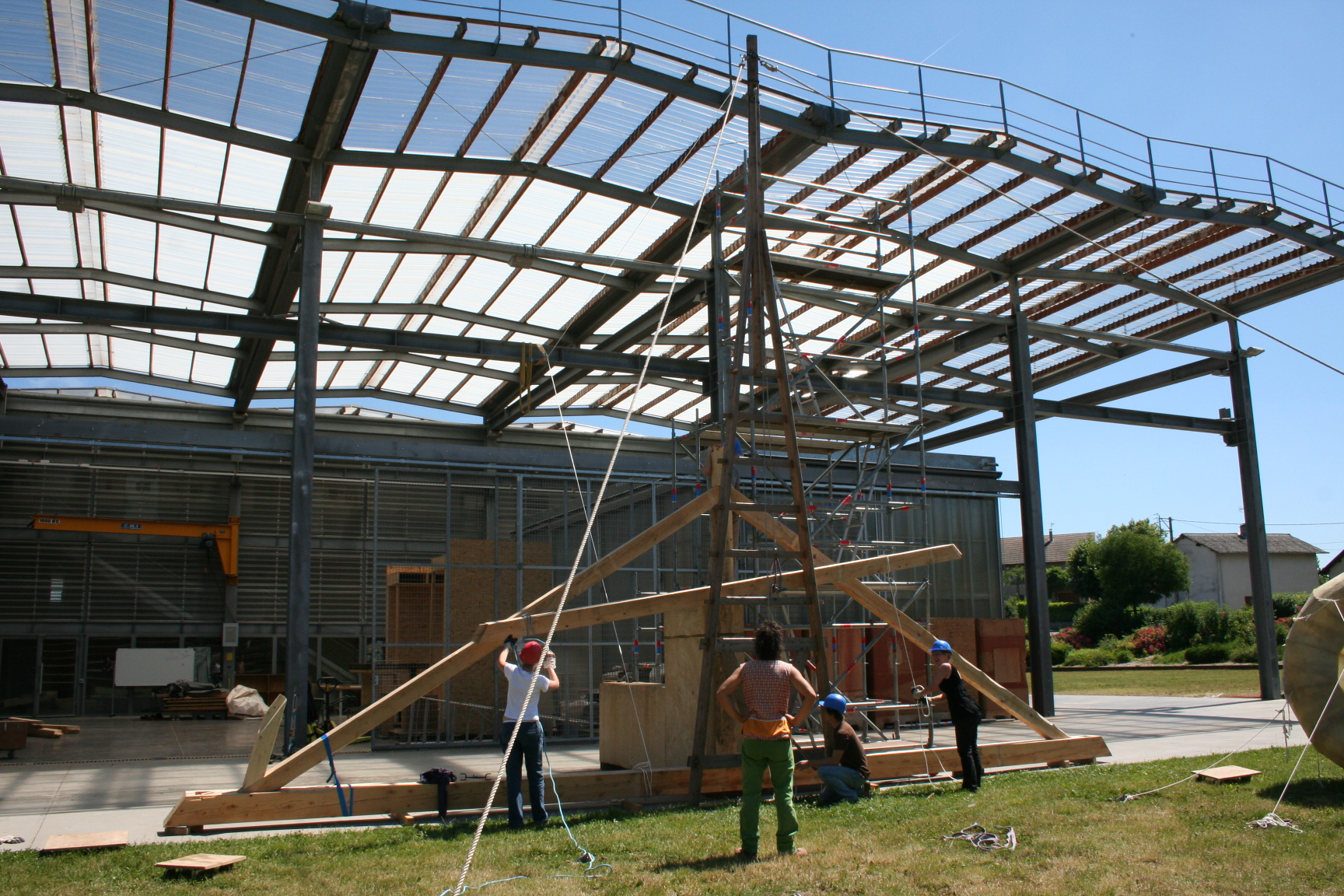
 © Chantier de la Sagrada Familia, Barcelone